Heading 2
Seven Line Items Quietly Inflating Your Utility Bills, and the AI Agents That Deflate Them
If you have ever stared at a utility bill and thought it might as well be written in ancient Sumerian, you are not alone. Most multilocation operators receive bills that run several pages, list a dozen or more line items, and offer almost no explanation of what any of them actually mean.
Jul 14, 2026
20 min
Index

If you have ever stared at a utility bill and thought it might as well be written in ancient Sumerian, you are not alone. Most multilocation operators receive bills that run several pages, list a dozen or more line items, and offer almost no explanation of what any of them actually mean.
Utility billing is genuinely complex. And that complexity has a cost. When you do not understand what you are paying for, you cannot catch what is wrong, and you cannot tell when you are simply on the wrong plan.
Those are two different problems, and it is worth separating them up front.
The first is billing errors: charges that are misapplied, miscalculated, or taxed under the wrong jurisdiction. Those are recoverable.
The second is suboptimal choices: bills that are calculated correctly but sit on a rate plan that does not fit how you actually use energy. Those are not refunds, they are forward savings.
This guide breaks down seven of the most commonly misunderstood line items on commercial utility bills. For each one we explain what it actually is, why it tends to go wrong, and what the financial stakes are, using real findings from accounts we analyze.
1. Supply Charges
Your utility bill is divided into two fundamental categories: supply and delivery. Supply charges cover the cost of the actual energy, the gas or electricity itself, before it ever gets to your building. Delivery charges cover the infrastructure that transports it to you.
In deregulated energy markets, supply is where real choices exist. Your utility may be the one procuring and supplying energy to you, in which case you are paying their rate, which may or may not be competitive. Or a third party supplier may be providing that energy under a separate contract, with the utility simply delivering it. Most operators do not know which situation they are in, or that the alternative even exists.
What can go wrong
In deregulated states, the default rate set by your utility is rarely the best available rate. Businesses that have not actively engaged in procurement, or that renewed contracts without shopping the market, can pay a premium over what is achievable. Gas prices in particular move with geopolitical conditions, seasonal demand, and commodity markets, so locking in the wrong rate at the wrong time compounds over a multiyear contract.
Supply is also where TrueMeter's rate optimization agent earns its keep. When it surveys the eligible options in your service area, it does not stop at the utility's own tariffs. In much of California and a growing number of other states, a Community Choice Aggregation program offers an alternative generation supply alongside the incumbent utility, often at a different price. The agent pulls those options into the same comparison, so the recommendation reflects the full set of choices available at your address, not just the default the utility put you on. The one thing it does not do is renegotiate a privately contracted commodity rate for you, which is a procurement conversation rather than a billing one, so for those we flag the gap and negotiate new rates with suppliers for you to simply approve if what we bring you provides stability and future savings.
2. Delivery Charges
Delivery charges cover the utility's cost of maintaining the infrastructure that moves energy from the grid to your facility: transmission lines, distribution networks, metering equipment, and customer service. Unlike supply, delivery charges are set by the regulated utility, so there is no shopping to be done here. What there is to check is whether they are calculated correctly.
What goes wrong
Delivery charges depend on how you are classified: your service class, rate schedule, and meter configuration. If any of those is wrong, you are being charged incorrectly by definition. We regularly see businesses on schedules designed for a different customer profile entirely, for example a small retailer billed on a high-demand commercial rate, or a hotel on a legacy tariff that a more favorable structure has since superseded. Our line item audit recomputes each delivery charge against the tariff in effect and flags the mismatch as a rate misclassification, with the recoverable amount attached.
3. Energy Charges
Energy charges are the consumption based component of your electricity bill. You pay for the number of kilowatt hours your facility uses. If your utility has deployed smart meters, increasingly standard for commercial accounts, they are measuring your usage in 15 minute intervals, around the clock.
That granularity matters because most modern rate structures are not flat. They are time-of-use rates, which means you pay different prices depending on when you consume electricity. On-peak periods, typically the afternoon into evening on weekdays, carry significantly higher rates than off-peak periods.
What goes wrong
Operators who do not know they are on a time-of-use rate often have no idea that running energy intensive equipment during peak hours carries a premium. HVAC systems, commercial kitchen equipment, and lighting loads that ramp up during the afternoon rush can quietly push energy costs well above what a modest shift in scheduling would achieve.
The gap between on-peak and off-peak pricing can be enormous, and it is the hinge that the right rate plan turns on. On one rate schedule we analyzed, the summer on-peak energy rate under one plan option runs about $0.85 per kWh, while the comparable option charges about $0.17 per kWh for the same window and recovers the difference through demand charges instead. Which of those is cheaper for you depends entirely on your load shape, which is the subject of the next two sections.
4. Demand Charges
Demand charges are one of the most misunderstood and most significant components of a commercial electricity bill. Unlike energy charges, which measure how much electricity you use over time in kilowatt-hours, demand charges measure the rate at which you draw electricity at its peak, in kilowatts.
Here is the mechanic: your utility measures your draw in 15-minute intervals throughout the month, takes your single highest interval, your peak demand, and uses that number to calculate the demand charge. For many commercial customers, demand charges represent a large share of the total electricity bill.
What goes wrong
A single anomalous 15-minute window, a piece of equipment malfunctioning or HVAC and kitchen equipment all cycling on at once, can set a peak that drives the charge for the whole month. Most operators have no visibility into their demand profile. They see a demand charge line, have no idea what caused it, and have no way to know whether their plan even makes sense given how they actually run.
Demand is also where we find outright billing errors, not just poor plan fits. On one California account, the utility prorated the demand charges on a 67 day billing cycle by multiplying them by 67 over 30, roughly 2.23 times, which inflated their facilities charge. But a demand charge is based on the single highest kilowatt reading in the period, and the utility’s own ruling document explicitly excludes demand from that kind of daily proration. Recomputing the line against the rule surfaced ~$3200 annual overcharge on a single account.
The anomaly detection agent output on the proration error with $3200 impact
The deeper issue is structural. Some plans recover most of their cost through high on-peak energy rates and charge little for demand. Others charge more for demand but far less for energy. For a facility with a high, predictable summer peak, such as a commercial kitchen, the demand heavy plan is usually far cheaper, because it trades a very expensive summer energy rate for a more manageable demand rate. For an eligible customer, getting this backward is one of the most expensive mistakes on the bill, and almost no one revisits it once the account is opened. The next section shows what happens when you do.
5. Rate Plan Assignment
Utilities offer multiple rate plans, or tariff structures, with different pricing mechanics. You are assigned one when you open an account, typically based on limited information such as meter size and estimated usage, and it is rarely revisited automatically. Over time your usage shifts, you add equipment, your peak profile evolves, and the plan does not move with you unless someone reviews it.
Doing that review properly means discovering every plan you are actually eligible for at your address, the utility tariffs and any Community Choice Aggregation options alongside them, comparing your real 15-minute interval usage against each, modeling the full bill, and finding the combination that minimizes cost. It also means respecting the rules utilities place on switching, which is where most simple comparisons fall apart. This is the work our rate optimization agent does, and the clearest way to show it is a real example.
We recently turned the agent loose on three kitchen locations run by the same operator, all in California. Same company, same utility. The agent returned three different answers.
At the first location, the account sat on a rate plan whose very high summer on-peak energy rates were a poor fit for a kitchen running at a high summer peak. Moving to another option, which recovers more through demand charges and far less through energy, produced savings of $15k, over nine billing periods, about 11 percent, which scaled to roughly $20k on an annualized run rate.
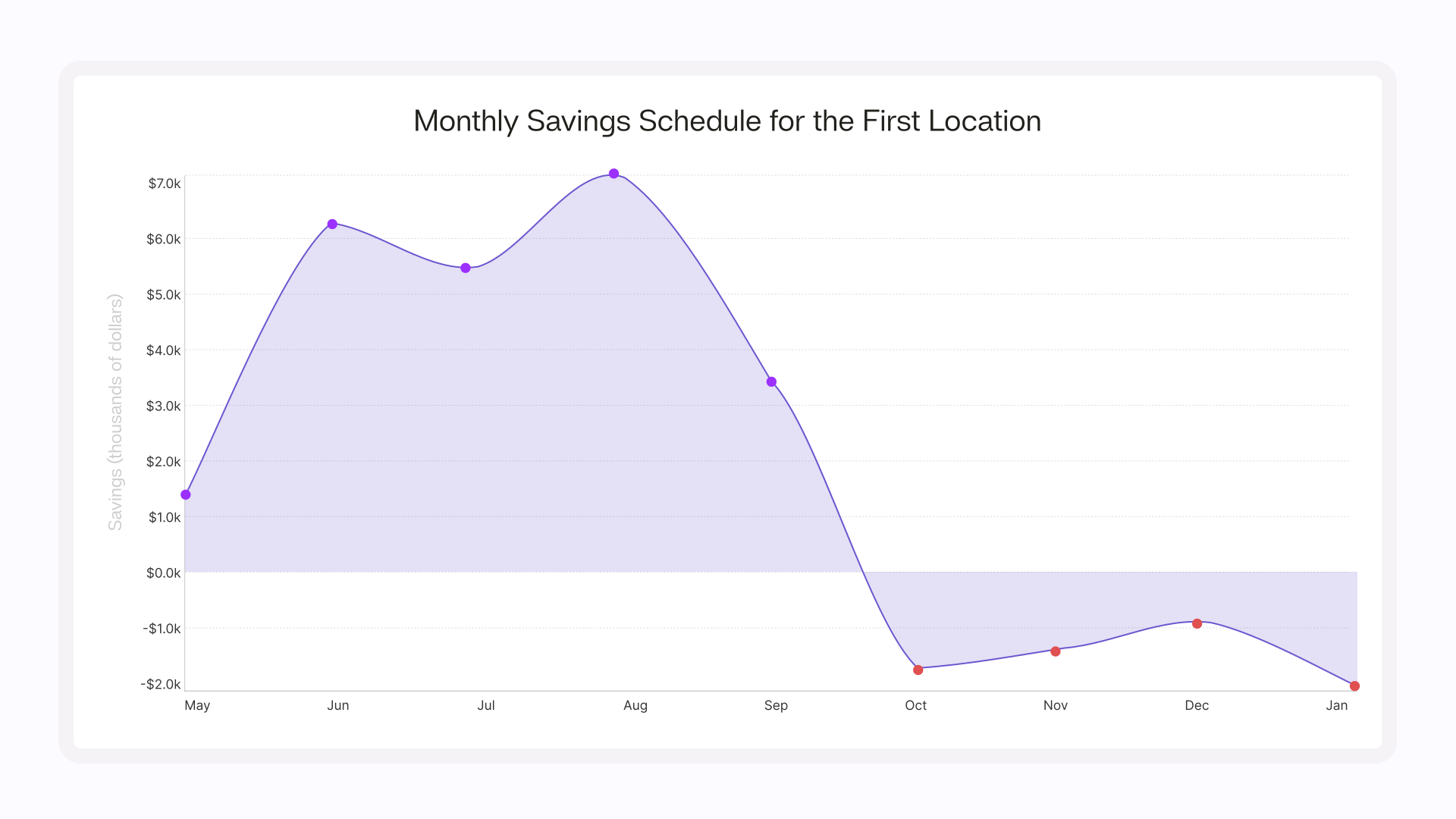
At the second location, the account had two meters. The agent left the smaller meter exactly where it was, because no other eligible plan beat it in any period. It recommended switching only the larger meter off its critical peak pricing variant. The net result was a more modest $1k over eight periods, about $1.5k annualized. The lesson is that the right move can be precise and small, and that touching the wrong meter would have cost money.
At the third location, the agent recommended no change at all, and the reason is the most interesting of the three. The winter months would in fact be cheaper on a different plan option, worth about $10k over the observed winter periods. But capturing that would require switching to the winter plan in the fall and switching back before summer to avoid that plan's punishing summer rates. That is two customer elected rate changes inside a rolling twelve month window, and the utility permits only one. Any switch also locks the account for twelve months. So the seasonally optimal play is simply not allowed as a repeatable strategy, and the correct recommendation is to stay put.
This is the part that separates real optimization from a spreadsheet that flags the cheapest plan each month. The agent builds its switch strategy as a mixed integer model with a hard cap on the number of changes per year, set to the maximum the utility actually allows, so it never recommends savings it cannot legally capture. Sometimes the right, defensible answer is to do nothing, and being able to say that with confidence is as valuable as finding a switch.
6. City and Local Taxes
Utility bills carry a range of municipal and local taxes: city taxes, county taxes, franchise fees, and surcharges that vary by jurisdiction. For a single location these are easy to verify. For a multilocation operator, every account sits in a different jurisdiction with a different rate that has to be applied correctly, every month.
What goes wrong
Tax errors are subtle and easy to miss, because the rates are small and they change for reasons that have nothing to do with your business. On one gas account, the authorized tax was billed at 10 percent, but a court settlement had temporarily reduced the rate to 9.91 percent, a change almost no operator would think to track. The audit caught both by recomputing the tax against the city code, citing the exact section, and attaching the recoverable amount to each. Multiply errors like these across hundreds of accounts in dozens of jurisdictions, each with its own rate and its own occasional adjustment, and the case for checking every line every month becomes obvious.
7. Late Fees
Late fees are penalties applied when an invoice is not paid by its due date. For a single account this is easy to manage. For an operator with dozens or hundreds of accounts across different utilities, each with its own billing cycle and due date, it becomes a full-time job that usually no one owns.
What goes wrong
Most operators do not have a dedicated utility management function. Payments fall to a controller, an accountant, or an operations manager for whom utility bills are one item on a long list. Bills get missed, payments run late, and fees accumulate. The math is unforgiving: a $50 late fee per location per month, across 100 locations, is $60,000 a year in entirely preventable cost. Because late fees are line items, we can total exactly what an account has paid over any period, which makes them one of the first things we surface in an initial audit, and often one of the easiest to stop with TrueMeter taking over the payments.
How We Prove It
The reason most operators never catch any of this is that doing so requires recomputing the bill against the rules that govern it, line by line, on every bill. That is exactly what the anomaly detection agent does. It does not sample, and it does not rely on a bill looking unusual compared to last month. It rebuilds each charge from the underlying tariff, rule, or municipal code, and it does this across thousands of bills, which is the only way findings this specific surface at all.
Every finding it produces carries the same backing:
- A type, such as rate misclassification, tax misapplied, tier allocation error, or proration error.
- A priority bucket by recoverable dollars
- A confidence level, where the highest tier requires the governing tariff to be cited and the arithmetic to reproduce exactly.
- An annualized recoverable amount.
- And a verification recipe that names the tariff document, the page, and the formula, so the finding can be checked rather than taken on faith.
The same agent works across electricity, gas, water and other utilities. On a water account it flagged a tier allocation error: the first tier allocation was frozen at a stale baseline of about 12 units a month while actual usage had grown to 167, pushing more than 80 percent of consumption into the higher second tier. The city water ordinance entitles the customer to a baseline re-evaluation once usage runs well above the old allocation. It is the same pattern as a stale rate plan: an assignment set once, never revisited, quietly costing money every cycle.
What This Adds Up To
Taken together, these seven line items show how much can be hiding in a commercial utility bill, and how much of it falls into one of two buckets: errors you can recover, and plans you can improve going forward.
At TrueMeter, we built an AI agent for each of these categories.
Our anomaly detection AI agent does the audit. It reads every bill, recomputes each line item against the governing tariff, rule, and municipal code, and flags anything that does not reconcile. It runs that line by line check across thousands of bills, which is what makes it possible to catch a single misapplied tax or a prorated demand charge that a person reviewing one account at a time would never reach.
Our rate optimization AI agent handles the forward savings. It identifies every rate plan you are eligible for in your service area, including the utility tariffs and any Community Choice Aggregation options, models each one against your actual interval usage, and produces a switch strategy that respects the real constraints, such as how many times a utility will let you change plans in a year. The result is not just the cheapest plan on paper, it is the cheapest plan you can actually move to and keep.
And once we surface those errors, we fix them.
[CTA]
Share article
Ready to see what your current vendor is missing?
Book a free audit. No cost, no commitment, and no disruption to your current setup. We'll show you exactly what's in your bills.
Resources
Learn more about energy savings
Stay up to date with our latest publications.
Why Operators Prefer TrueMeter Over Schneider Electric
Schneider Electric is a utility bill payment service owned by Schneider Electric SE, a French multinational corporation that has offerings in physical generation assets, energy technology, and digitalization for industry. Their bill pay platform processes utility bills for multi-location businesses at $3-17 per bill with no savings optimization. This per-bill model creates a structural misalignment. Schneider Electric is paid the same amount whether or not your bill is accurate or optimized.
CFOs
Engineers
Operators
30 Apr 2026
|
5 min
Why Operators Prefer TrueMeter Over Engie Impact
Most utility bill management providers focus on one outcome: getting invoices paid on time. Engie Impact fits that mold. Their service centers on collecting bills, running tolerance checks, and presenting consolidated invoices for funding, while clients pay on a per-invoice basis with no direct link between fees and the savings produced.
Engineers
Operators
CFOs
30 Apr 2026
|
5 min
Keeping Utilities Honest: The TrueMeter Story
I've lived and worked in many different cities and countries throughout my life. Across all of them, I've yet to find one where utilities worked properly, charged fairly, and didn't spark controversy. The frustrations seemed universal: confusion over electricity bills that don't make sense, costs that surge without explanation, and that nagging feeling you're being overcharged.
CFOs
Engineers
Operators
30 Apr 2026
|
7 min